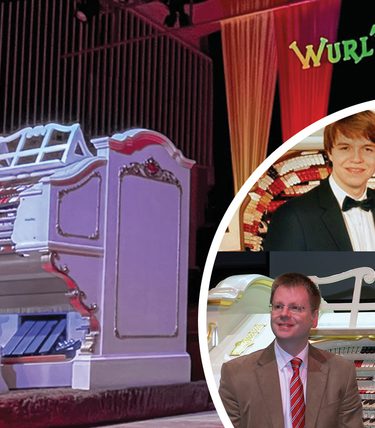
About Wurlitzer Organ Concert: David Gray and Simon Gledhill
Experience the Magnificence of the Wurlitzer Theatre Organ at the Assembly Hall.
Worthing’s wonderful Wurlitzer is one of the largest theatre organs in England. The sound you hear is produced from over 1,500 organ pipes installed in the two organ chambers located behind the grilles either side of the stage. The pipes range from 2 inches to 16 feet in length. Alongside these pipes are real percussion instruments - a Xylophone, Sleigh Bells, Drums, Cymbals and even a set of Cathedral Chimes! The organ is a powerful instrument using air produced by two 5KW blowers housed under the stage. The console is also housed under the stage but rises majestically to its playing position on a lift - as all proper theatre organs should.
In the mid 1970’s the organ was acquired by Jim Buckland and the Sussex Theatre Organ Trust, and was rebuilt and installed in the Worthing Assembly Hall. The organ was opened in 1981 and was later enlarged from 10 ranks (sets of pipes) to 23 ranks following the acquisition of an organ from the BBC. As part of this enhancement the organ was tonally finished (i.e. adjusted to suit the hall it was in) by leading American technicians, so that what you hear now is one of the finest theatre organs in Europe.
Simon Gledhill
Born in Yorkshire, Simon Gledhill Is considered to be one of today’s foremost Theatre Organists: he is known for his highly musical interpretations of popular and light music on the organ and is admired by his musician peers for his admirable technique, imaginative and beautiful interpretations.
Simon began learning to play the piano accordion at age six and continued with that instrument for eleven years, winning several competitions along the way. When he was ten, his parents purchased a small electronic organ. After initially teaching himself to play it, he commenced formal studies and in 1982 he entered and won the Northern Young Theatre Organist of the Year competition. This led to broadcasts on the BBC Radio 2 “The Organist Entertains” program.
The broadcasts resulted in a flurry of concert offers, and Simon has since performed at all the major theatre organ venues in Britain, as well as touring in Germany, Holland, Australia, New Zealand and the USA. There have been numerous appearances at Annual and Regional Conventions of the American Theatre Organ Society including the 2018 Pasadena Convention.
He combines his concert and recording activities with work as Southern District Secretary of the Cinema Organ Society, the UK’s leading theatre organ preservation group, and a full-time career in corporate finance, based in London.
David Gray
David was born in 1990 and has being playing the theatre organ since he was 16. David has established himself as an extremely versatile and creative musician over a vast array of genres, equally at home with arranging music and performing. He studied piano at the Royal Academy of Music on full scholarships from 2008 to 2015 with Hamish Milne. During this time David received numerous prizes and scholarships including the Patrons' Award and the Walter Macfarren Gold Medal. He is now Professor of Piano at the Royal Academy of Music.
Since graduation, David's performing career has taken him through Europe, the USA and Australasia. Along with piano, a large part of his career comprised performances on symphonic and theatre pipe organs, mainly as a transcription artist. A key factor in David’s success as a theatre organist is the breadth of his repertoire: this includes faithful reproductions of numbers made famous by the best of theatre organists, such as Sydney Torch and George Wright. He also specialises in playing highly original and ambitious transcriptions of large orchestral pieces including Night on a Bare Mountain by Mussorgsky and even Tchaikovsky’s 1812 Overture. David stopped playing organs publicly in 2020 in order to turn his focus elsewhere.
From 2020-2023 David served as an Artistic Director of the Temple of Art and Music, a chain of venues which he helped build in London. His most recent projects, aimed at new audiences and recording methods, has involved combining piano, electronics and sound production. This has led to some revolutionary performances in the realisation of piano repertoire and sound dispersal in specific environments.